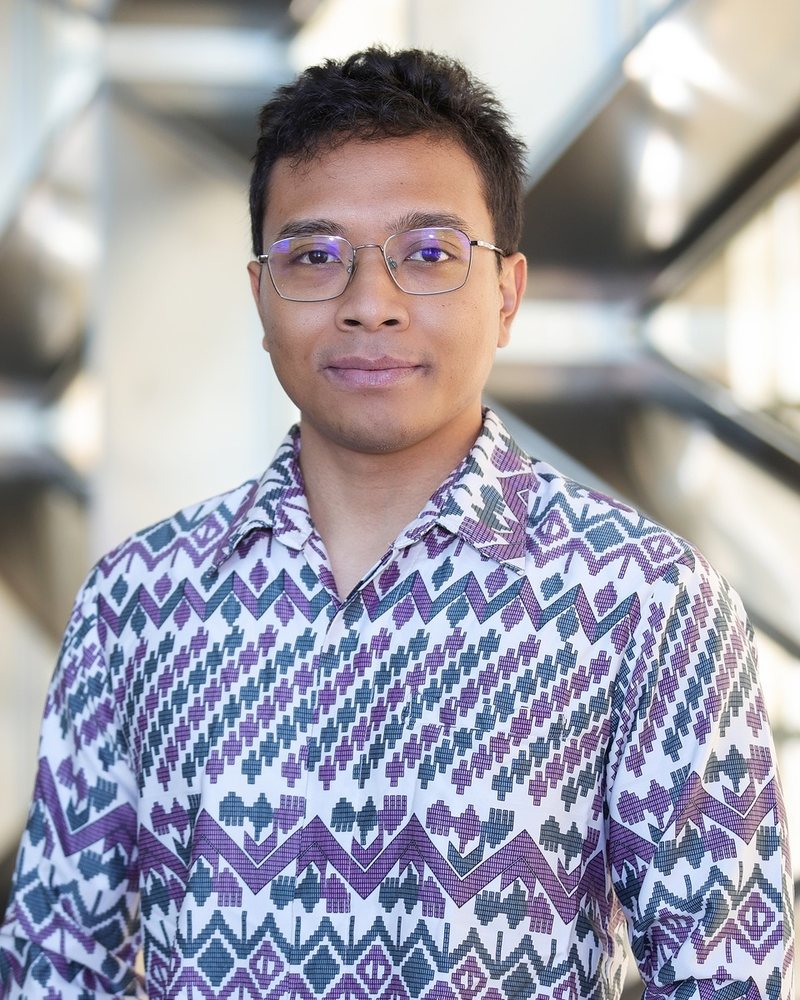
Dr. Kadek Hendrawan Palgunadi
I build physics-based earthquake simulations and AI-driven seismic monitoring systems, from seismometer networks to fibre-optic Distributed Acoustic Sensing (DAS), turning raw seismic data into fast, reliable information for geothermal operators, cities and researchers.
- Assistant Professor, Geophysical Engineering, Institut Teknologi Sepuluh Nopember (ITS)
- Founder & Lead Developer, LithoQuant
- Principal Investigator, Computational Seismology Research Group
- ETH ZurichPostdoc, Swiss Seismological Service
- KAUSTPhD, Earth Science & Engineering
- IPGP ParisMSc, Seismology
- ITBBSc, Geophysical Engineering
From seismic sensors to decisions
I work across the full chain: acquiring and processing seismic data, building machine-learning models on top of it, and simulating the physics of earthquakes on high-performance computers.
Real-time seismic monitoring
Monitoring systems with automatic, AI-assisted event detection, location and processing, from sensor to dashboard.
Deep learning for seismic data
Seismic denoising, generative waveform models (denoising diffusion) and ML-based event characterization.
Earthquake simulation on HPC
3D dynamic rupture and ground-motion modelling with SeisSol for fault hazard and cascading-rupture scenarios.
Induced seismicity & geothermal
Microseismic detection and location, and separating induced from natural earthquakes in geothermal fields.
Distributed Acoustic Sensing (DAS)
Turning fibre-optic cables into dense seismic arrays, including the ITS campus fibre network, and processing DAS data for monitoring and earthquake studies.
Fault & seismic hazard
Fault characterisation, stress mapping and earthquake scenarios for seismic hazard assessment in Indonesia.
Real-time seismic monitoring with automatic AI processing
Together with Pertamina Geothermal Energy and Pemerintah Kota Surabaya, I am building a real-time monitoring system that detects and processes seismic events automatically, using AI to reduce the time from recording to actionable information.
All current research projects- Continuous, real-time acquisition of seismic data
- AI-based automatic detection and processing of events
- Monitoring for geothermal operations and urban seismic hazard
Recent highlights
Fault size–dependent fracture energy explains multiscale seismicity and cascading earthquakes
Physics-based simulations showing how fracture energy scales with fault size, linking small and large earthquakes.
Read paper JGR: Machine Learning · 2025High-resolution seismic waveform generation using denoising diffusion
A generative AI model that synthesises realistic, high-resolution seismic waveforms for ground-motion applications.
Read paper Comms. Earth & Env. · 2025Rupture dynamics and velocity structure effects on ground motion during the 2023 Türkiye earthquake doublet
Supercomputer simulations of the 2023 Türkiye earthquakes explaining the observed ground shaking.
Read paperBackground
I am an Assistant Professor in Geophysical Engineering at Institut Teknologi Sepuluh Nopember (ITS), Indonesia, where I lead the Computational Seismology Research Group at the Petrophysics Laboratory, and the Founder and Lead Developer of LithoQuant.
Before returning to ITS full-time, I was a Postdoctoral Researcher at the Swiss Seismological Service (SED), ETH Zurich (2024–2026), working on generative AI for seismic waveforms and earthquake source physics. I received my PhD from KAUST under Prof. P. Martin Mai, my MSc in Seismology from IPGP Paris and my BSc from Institut Teknologi Bandung.